Provision Planning
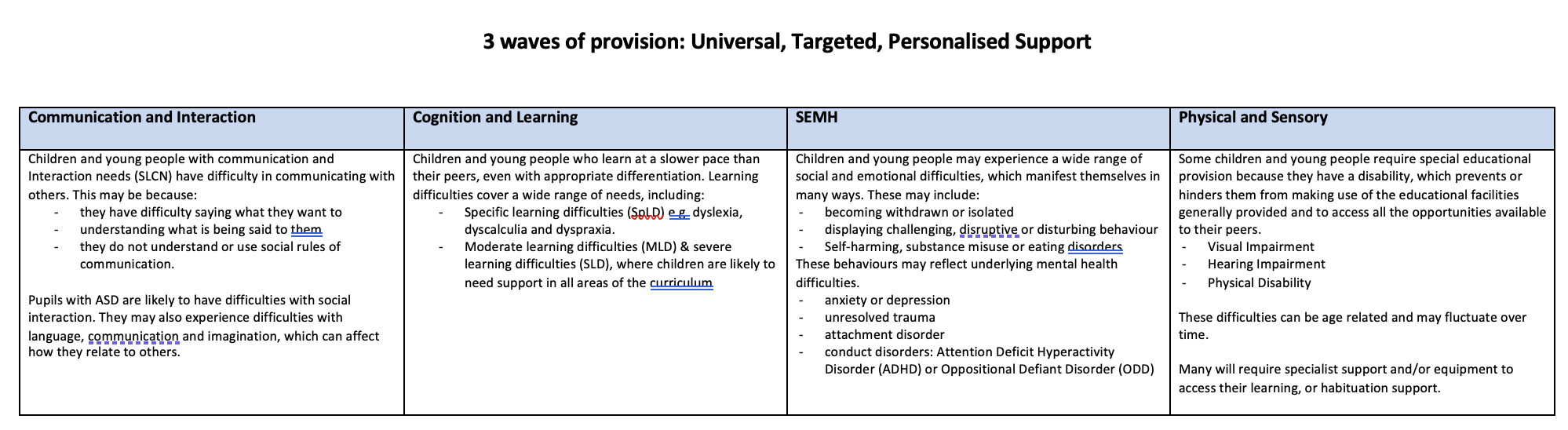
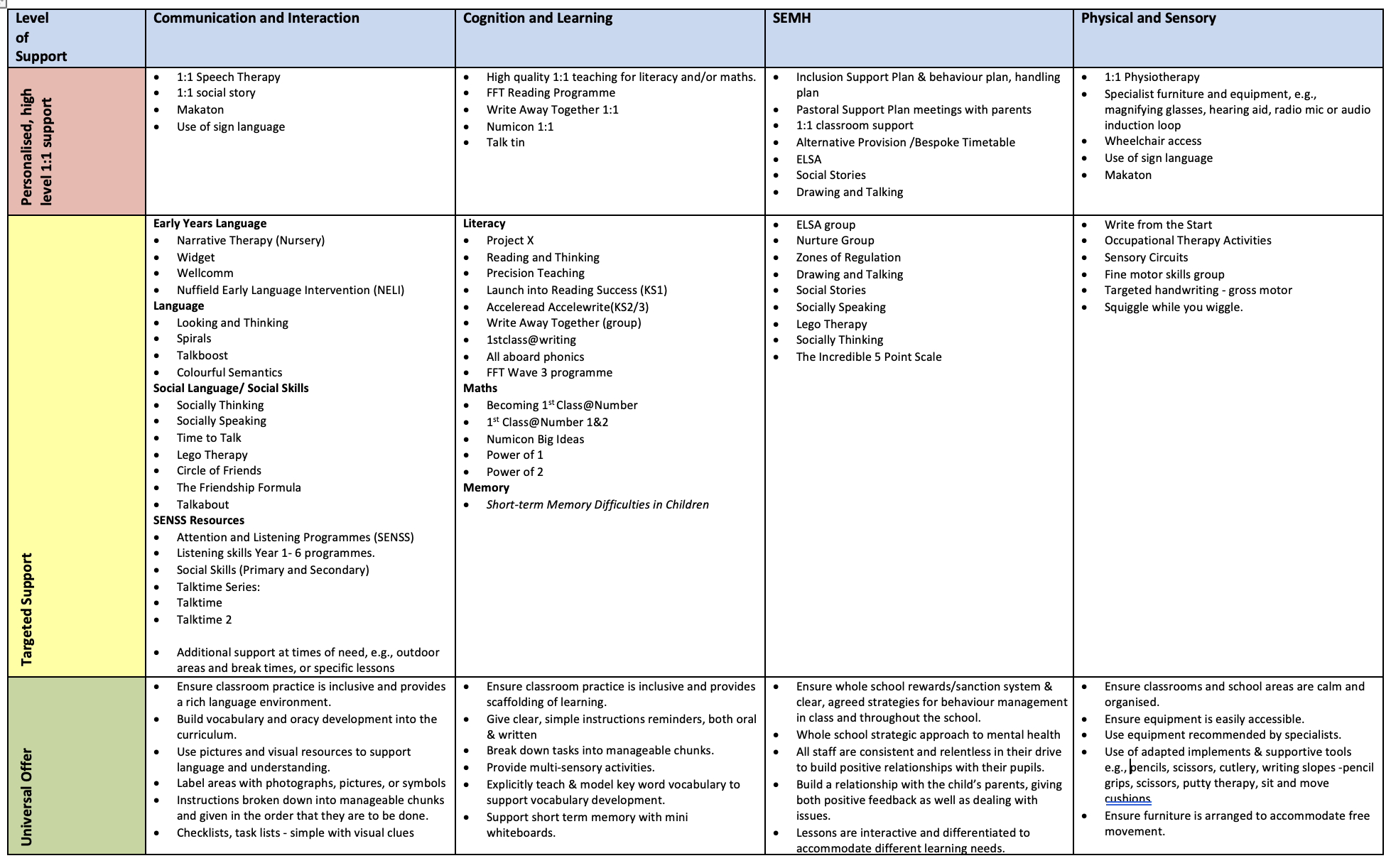
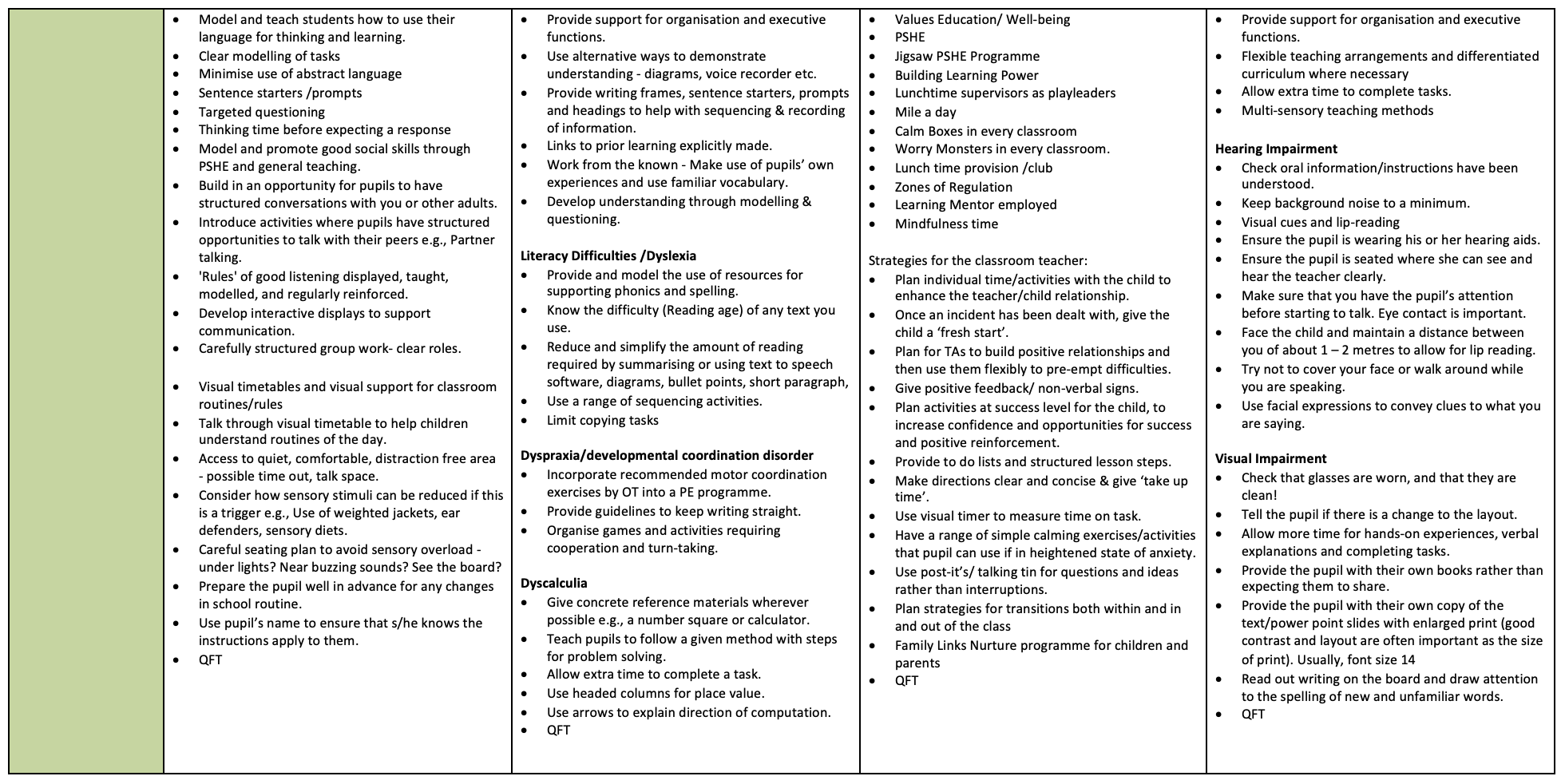
Provision Planning using 3 waves for inclusive practice
and Quality First Inclusive Teaching
The three-tier provision planning below is underpinned by the principles of Quality first teaching (QFT), as outlined in the SEND Code of Practice (2015), and primarily focusses on the inclusion of all pupils in high quality, everyday teaching. It is an approach which ensures every pupil can access every lesson in a way they are able to achieve and progress.
Generic Principles of Quality First Teaching
- Lessons are highly focused with clear learning outcomes
- High expectations of learner engagement and learners taking responsibility for their own learning
- Opportunities are in place for learners to succeed, develop independence as well as being challenged
- Opportunities for interactions for all learners and an emphasis on learning through dialogue
- Knowledge and understanding are not assumed
- Regular use of praise to engage and motivate learners
- Keywords visible and referred to within lessons
- Examples and models support learners accessing tasks
- A range of resources and strategies are evident in planning and delivery - visual aids, concrete and visual resources, hands-on and experiential opportunities, Literacy Mats, Dictionaries and Thesauri, use of symbols, pictures and colour, use of memory aids, visual stimuli, songs and rhymes, etc.
- Links to prior learning: revisiting & revision, refer to previous work, use of mind maps etc. to show links
- Regular revision and repetition: Think of it as a spiral of learning where you keep returning to a topic, with increasingly long periods in between each return; this is sometimes called spaced practice
- Clear, structured lessons enable classwork to be varied including independent, pair and group work to support with developing independence as well as group work skills
- Break up learning tasks: build in movement from one task to another where possible, change pace, change activity, use breaks; new learning needs time to ‘bed in’ and breaks can help that process